Buying Guide
Operations
Hotel Direct Billing & City Ledger: The Complete Guide
4 min read
If your hotel works with corporate accounts, travel agencies, government travelers, or any organization that pays after checkout, you're dealing with direct billing — whether you call it that or not.
The problem? Most hotels still manage it with spreadsheets, paper invoices, and manual follow-ups. Payments get delayed. Aging receivables pile up. And front desk staff spend hours on billing instead of guests.
Here's what direct billing and city ledger management actually are, why they matter, and what a modern PMS does about them.
What Is Direct Billing in Hotels?
Direct billing (also called company billing, bill-to-company, or credit billing) is an arrangement where a hotel invoices a company or organization after the guest checks out, rather than collecting payment at the front desk.
Common scenarios:
- Corporate accounts — a company books rooms for employees and is invoiced monthly
- Travel agencies — the agency pays the hotel for the guest's stay after the fact
- Government and military — travelers present authorization and the agency is billed
- Event groups — conference organizers are billed for attendee room blocks
- Airline crews — airlines contract with hotels for crew layovers at negotiated rates
Instead of swiping a credit card at checkout, the guest's charges are transferred to the company's city ledger — a running account of what that organization owes.
What Is a City Ledger?
The city ledger is your hotel's accounts receivable book — an accounting record of all charges owed to the hotel by third parties who aren't currently checked in. It's separate from the guest ledger, which tracks in-house guests.
When a guest checks out under a direct billing arrangement, their folio balance moves from the guest ledger to the company's account in the city ledger.
A well-managed city ledger gives you visibility into outstanding balances, aging analysis, collection priorities, and cash flow forecasting — the foundation of healthy corporate-travel revenue.
Why Direct Billing Matters More Than You Think
Hotels that offer direct billing to corporate clients see significantly higher repeat booking rates from those accounts. Companies want frictionless travel for their employees. If your hotel requires each traveler to pay individually and submit expense reports, you'll lose that business to competitors who offer direct billing.
But there's a catch: poorly managed direct billing kills your cash flow.
What typically goes wrong:
- Invoices go out late, or not at all
- Nobody tracks which invoices are overdue
- AR aging creeps past 90 days before anyone notices
- Write-offs pile up at year-end
- The front desk doesn't know which companies are approved for direct billing
How a Modern PMS Handles It
A modern PMS treats direct billing as a first-class workflow — not a feature you bolt on with spreadsheets later.
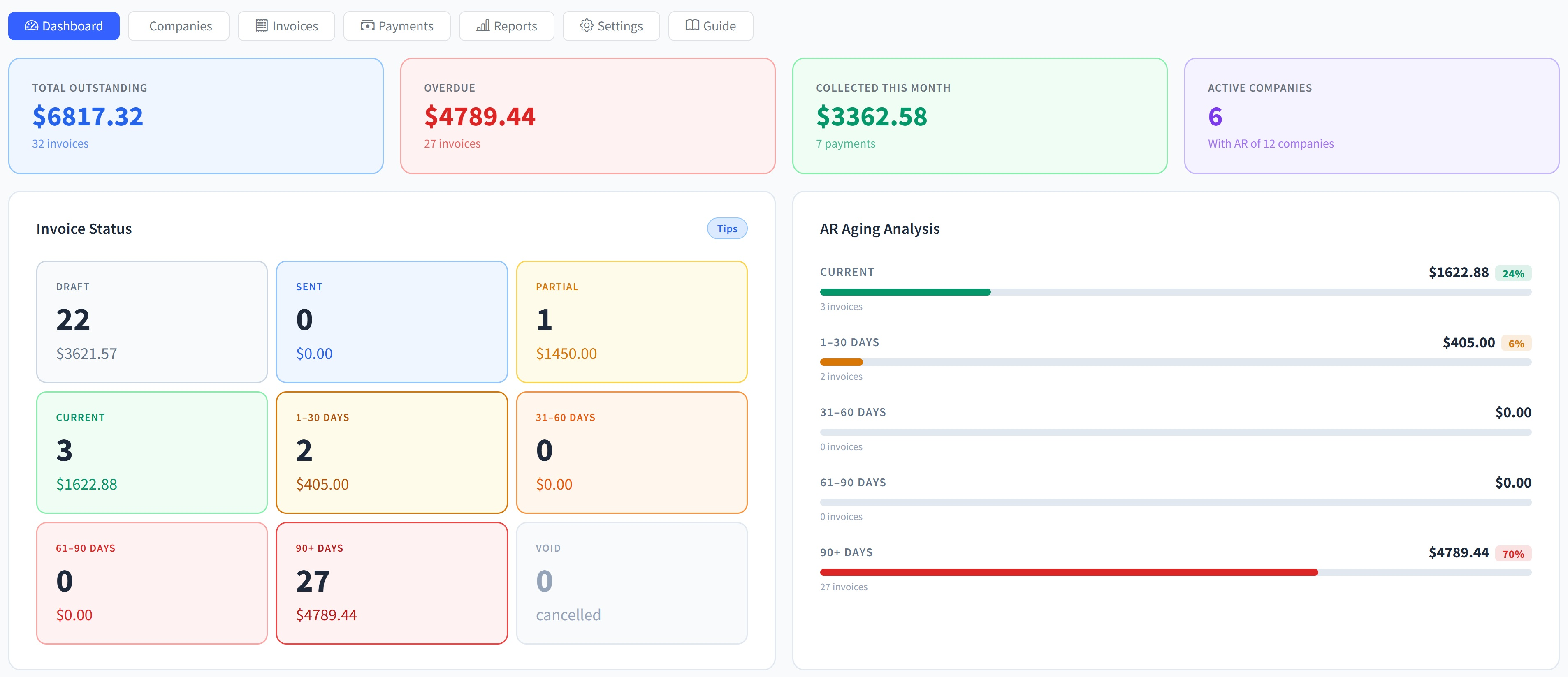 InnSyst Direct Billing Dashboard — real-time overview of outstanding invoices, AR aging analysis, and company billing status
What that looks like in practice:
A real-time AR dashboard. Outstanding balances, overdue totals, this-month collections, and active company accounts all visible at a glance. No exporting CSVs, no waiting for accounting reports.
Invoice lifecycle tracking. Every invoice flows through clear stages from generation to collection, with aging surfaced as the invoice gets older. No invoice falls through the cracks.
AR aging analysis. Receivables broken down by time bucket with percentage distribution — the same report your accountant needs, generated automatically.
Company management. Profiles for each corporate account: billing address, payment terms, credit limit, rate agreement. When a guest checks in under a company account, the front desk knows instantly whether direct billing is approved.
The dashboard becomes a daily snapshot of your corporate revenue health, not a quarter-end accounting chore.
Where Direct Billing Sits in the Bigger Picture
Direct billing is one of several payment paths a hotel uses:
| Method | When payment happens | Who pays | Best for | |--------|---------------------|----------|----------| | Direct Billing | After checkout (invoiced) | Company / organization | Corporate accounts, agencies | | Credit Card Guarantee | At checkout | Guest | Individual travelers | | Prepayment | Before arrival | Guest or company | High-risk bookings, events | | Cash / Walk-in | At check-in or checkout | Guest | Walk-in guests | | OTA Virtual Card | After checkout (auto-collected) | OTA | Online bookings |
The bigger your corporate business, the more direct billing carries the load.
Common Names for the Same Concept
Different regions and PMS systems use different terminology:
- Direct Bill / Direct Billing — most common in North America
- City Ledger — accounting term for AR from non-in-house sources
- Company Billing / Corporate Billing — common in business travel
- Credit Billing — used in some European hotels
- Bill-to-Company (BTC) — corporate travel term
- Debtors Ledger — British / Australian term
Different name, same mechanics: a guest stays, the charges go to a company account, you collect later.
See It on Your Own Data
Direct billing is included on InnSyst's Starter and Professional plans — no add-on, no per-invoice charges.
Book a demo and we'll walk through the Direct Billing dashboard with your own property's data.
Related Articles
Ready to try InnSyst?
See how InnSyst can streamline your property operations. Book a free demo and get set up in under an hour.
Book a DemoNo credit card required. Free setup and onboarding included.